 By Steeve
Tamarindo isn’t one wave. It’s a 2 km stretch of Pacific sand with three named peaks inside the main bay, a long right at the river mouth when sandbars line up, and four better waves within an hour’s drive. Add year-round surf and a learner-friendly main beach and you have the busiest surf town in Costa Rica’s Guanacaste province.
Here’s how to read the spot before you arrive: what breaks where, when to come, what to ride, and which beach is worth the drive when Tamarindo gets crowded.
| Wave type | Beach break, river mouth, plus the occasional reef section |
|---|---|
| Levels served | First-timer to advanced, with different peaks for different levels |
| Best season | Year-round. Dec to Apr for beginners, May to Nov for intermediates and up. July and August are the sweet spot. |
| Swell direction | SW (May to Nov) and NW (Dec to Apr) |
| Best wind | Easterly offshore, dominant through the dry season |
| Crowd factor | High. Tamarindo is the most surfed beach in Guanacaste |
| Hazard to know | Crocodiles live in the Tamarindo estuary. Don’t cross on foot. |
Most surfers arriving in Tamarindo think of it as “one beach break.” It isn’t. The bay has three named peaks plus a river mouth, each working off different sandbars and tide ranges.
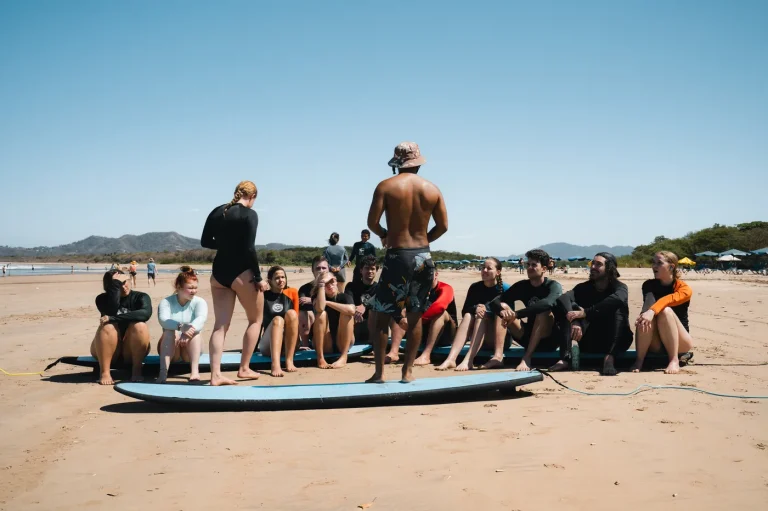
The long stretch of sand directly in front of town is what most beginners actually surf. Sandy bottom, multiple peaks, gradual takeoff zones. High tide produces softer, more forgiving waves and is the standard window for first-timers and groups in lessons. Mid to low tide sharpens everything up: faster takeoffs, more defined shoulders, and currents that get stronger.
What you find at high tide: long, forgiving lines well-suited to beginners and longboarders, running for hundreds of metres along the main beach.
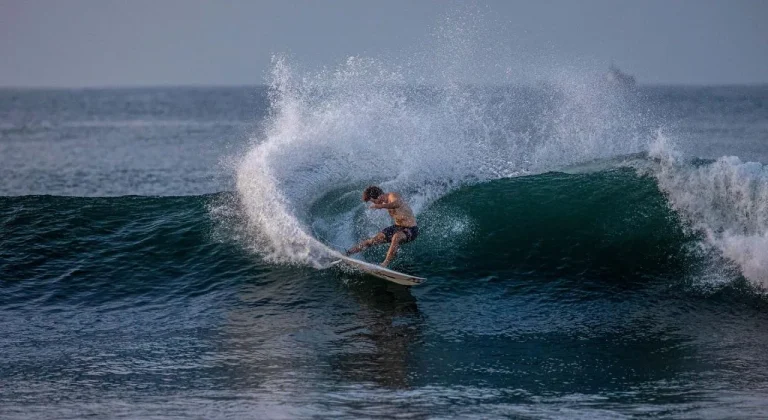
Pico Pequeño sits on the northern end of the bay. A lava thumb reef just offshore refracts incoming swell into a wedging A-frame that breaks close to the beach. Witch’s Rock Surf Camp describes the result as “neat wedges” with predominantly left shoulders. It’s punchier than the main beach, has a more defined peak, and rewards positioning.
Not a beginner wave. The wedge breaks fast and close to dry rock when the swell picks up.
Pico Grande is the rocky, exposed peak immediately north of Pico Pequeño. When it’s overhead, it produces what locals call “an extremely punchy wedge.” This is the wave you watch the advanced surfers paddling for. Heavy on positioning, heavy on currents.
Skip it as a learner. Watch it for an hour from the beach and you’ll see why.
The river mouth sits at the northern end of Playa Tamarindo, where the Tamarindo estuary empties into the sea. When the sandbars are right and the swell hits, you get a right-hand river-mouth wave that can peel for up to 200 metres. It’s the wave Tamarindo is technically known for in surf publications.
Two things matter here: the wave moves from deep to shallow water fast and tends to double up on the sandbar, and the estuary itself is home to crocodiles. More on that below.
Tamarindo has waves year-round. What changes is size, swell direction, and how clean it is.
Smaller, cleaner conditions. Waves in the 1 to 4 ft range. NW swells push through periodically. The dry season delivers offshore easterly winds that groom the incoming surf into clean lines. This is Tamarindo’s beginner window: gentle, predictable, busy with surf schools.
Water temperature drops slightly. A thin wetsuit top or rashguard is the call for early-morning sessions, because the upwelling that kicks in from around December can produce some cold onshore winds at first light.
Bigger waves. SW swells coming up from the South Pacific. Wave heights climb to 6 ft and above on the right days. This is Tamarindo for intermediate and advanced surfers, and for anyone willing to put in the time at the main beach when the river mouth is firing.
Water warms up. Rashguard is fine. Yes, it rains, usually a daily afternoon downpour rather than all-day grey.
These two months get their own category. Costa Rica calls them the “mini-summer”: solid green-season swells layered with dry-season skies and offshore winds. If you can only book one window of the year, this is it.
Tamarindo is the most surfed beach in Guanacaste. Surf schools start lessons at 7 am at the main beach. By 9 am you’ll see 60+ people in the water at the main peak on a typical day.
The trade-off: instructors are everywhere, lesson prices are competitive, and the wave is forgiving enough that crowded line-ups don’t get aggressive. If you want space, paddle further north toward Pico Pequeño, get in the water before 7 am, or drive to one of the day-trip spots below.
This is the headline. Crocodiles live in the Tamarindo estuary at the mouth of the Tamarindo River. They’re listed as a hazard on every surf-spot database, including Magicseaweed, Surfline and Witch’s Rock’s own guide. The risk isn’t surfing the river-mouth wave itself, since the take-off sits offshore. The risk is walking across the estuary to get to Playa Grande on the other side. Don’t do it. Take the boat (5 minutes from the marina) or drive the long way around.
Tamarindo is highly tide-dependent. The same peak that’s clean at high tide can be flat and sectioning at low tide. Check the tide chart before you paddle out. Local rule of thumb: the river mouth tends to fire on incoming tides, the main beach softens at high tide.
Stronger at mid-low tide and on bigger days, especially at the river mouth and Pico Pequeño. Standard ocean-safety rules: don’t paddle out alone on big days, know your exit point on the beach, and don’t fight the current. Swim parallel to shore.
When Tamarindo is small, blown out, or just too crowded, you have options.
The closest alternative. A 10-minute walk south of Tamarindo along the beach. Lefts and rights over a sandy bottom. Picks up more swell than Tamarindo, so when the main beach is small Langosta can be twice the size. Best on low to mid tide with at least 1 metre of swell. Fast and powerful when it’s on.
The Pacific coast’s most consistent beach break in this area. Long stretch of beach, left and right peaks, square tubes when conditions stack up. It sits inside Parque Nacional Marino Las Baulas, so the beach is protected from over-development.
Best at mid-tide, roughly three hours either side of high. Holds size better than Tamarindo on big swell days. Less crowded because access is harder: you either take the 5-minute boat shuttle from the Tamarindo marina (cheap, runs all day) or drive the 30-minute detour around the estuary.
One note that matters: Playa Grande is also a leatherback turtle nesting beach from December to February. The park enforces strict night-time rules during that window, but daytime surfing isn’t restricted.
A series of breaks rather than one wave. Rocky reefs, beach breaks, and a second river mouth spread across about a kilometre of coast, including the section locals call Little Hawaii. Picks up more swell than Tamarindo, so it’s the obvious move on small days.
Costa Rica’s reef-break standard. Fast, hollow barrels that have made Negra famous since the surf movie Endless Summer II. Best at high tide. Low tide exposes the rock shelf and you don’t want to fall on that.
Advanced only. Don’t drive to Negra unless you can handle a fast right-hand reef wave with consequences.
The famous ones. Witch’s Rock is the offshore break inside Santa Rosa National Park, accessible only by boat from Tamarindo. Trips typically run 2 to 3 hours each way, often shared with other surfers. Ollie’s Point is the long right point further north. Both are upper-intermediate to advanced and the boat day itself is a half-day commitment.
Several operators run the trip out of Tamarindo, with Witch’s Rock Surf Camp the operator most associated with it.
A quick guide, not exhaustive.
Most surf shops in town rent everything from soft-tops to high-performance shortboards. If you’re staying with a surf camp that includes board use, you can usually swap freely between lessons.
Tamarindo town has the densest concentration of surf accommodation in Costa Rica. Three considerations matter when you book.
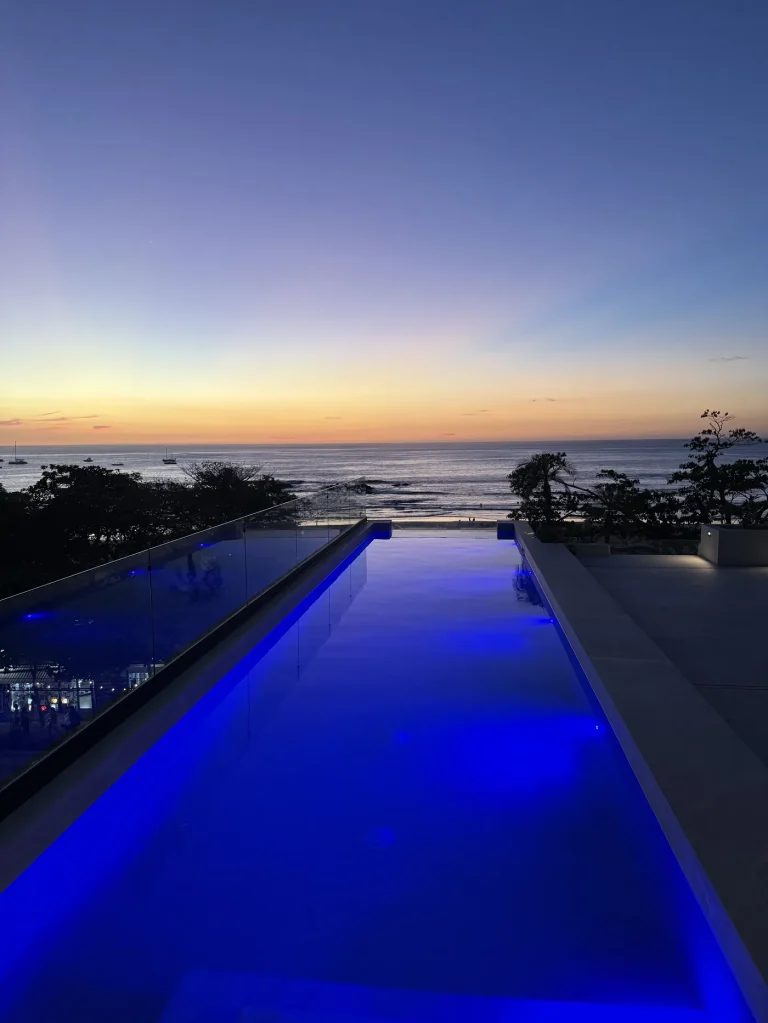
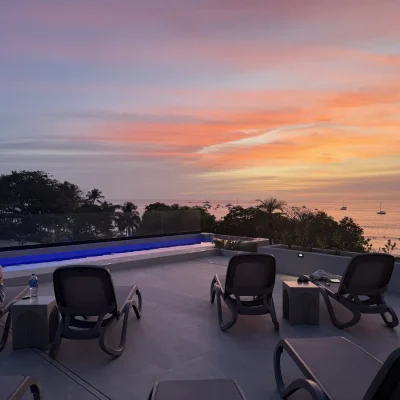
Iguana Surf Boutique Hotel sits behind the main beach and runs the structured-coaching version of Tamarindo: rooftop infinity pool overlooking the coast, daily lessons with video review, photo package included, and Liberia Airport pickup. Packages start from 5 nights, Saturday to Saturday, with from-prices around $806 for the 5-night base. The Iguana Surf shop has been running in town since 1989, and the boutique hotel is the newer hospitality side of the same family business.
For our comparison on whether Tamarindo is the right Costa Rica base for you, versus Nosara and Santa Teresa, see the separate guide linked at the foot of this article.

 English
 Français
  Deutsch
  Español
  Italiano