 By Steeve
Costa Rica’s Pacific coast has built itself into one of the world’s busiest surf-camp markets. Tamarindo alone runs at least five major operations within walking distance of each other. Add the camps in Playa Grande, Avellanas, Nosara and Santa Teresa and you’re looking at thirty-plus places marketing themselves as “the best surf camp in Costa Rica.” Most of them aren’t actually comparable: a $2,290-per-week premium coaching camp and a $25-per-night budget hostel both end up in the same Google search.
Here are five we’d actually send a friend to, why each one suits a different kind of guest, and what each one costs. Honest disclosure up front: we run booking for one of these (Iguana Surf Boutique Hotel) and we list it first because we know its product in detail. The other four are independent. We’ve checked the reviews and the published packages, and we’ll be transparent about the trade-offs on each.
| Camp | Where | Best for | From (per week) |
|---|---|---|---|
| Iguana Surf Boutique Hotel | Tamarindo (beachfront) | Structured coaching, boutique stay, video review | $806 / 5 nights base |
| Witch’s Rock Surf Camp | Tamarindo (main strip) | Tiered programmes, boat trips to Witch’s Rock and Ollie’s Point | $2,290 (Beginner) to $3,190 (Advanced + boat) |
| Dreamsea Surf Camp | Tamarindo (jungle side) | Eco-glamping, social atmosphere, ages 18 to 30 | $445 (dorm) to $1,500 (River Suite) |
| Rapture Surfcamps Costa Rica | Playa Avellanas | All-inclusive resort feel with surf + yoga + meals bundled | ~$840 to $1,260 (7 nights) |
| Playa Grande Surf Camp | Playa Grande (national park) | Budget travellers escaping Tamarindo’s crowd | $23 to $34 / night dorm |
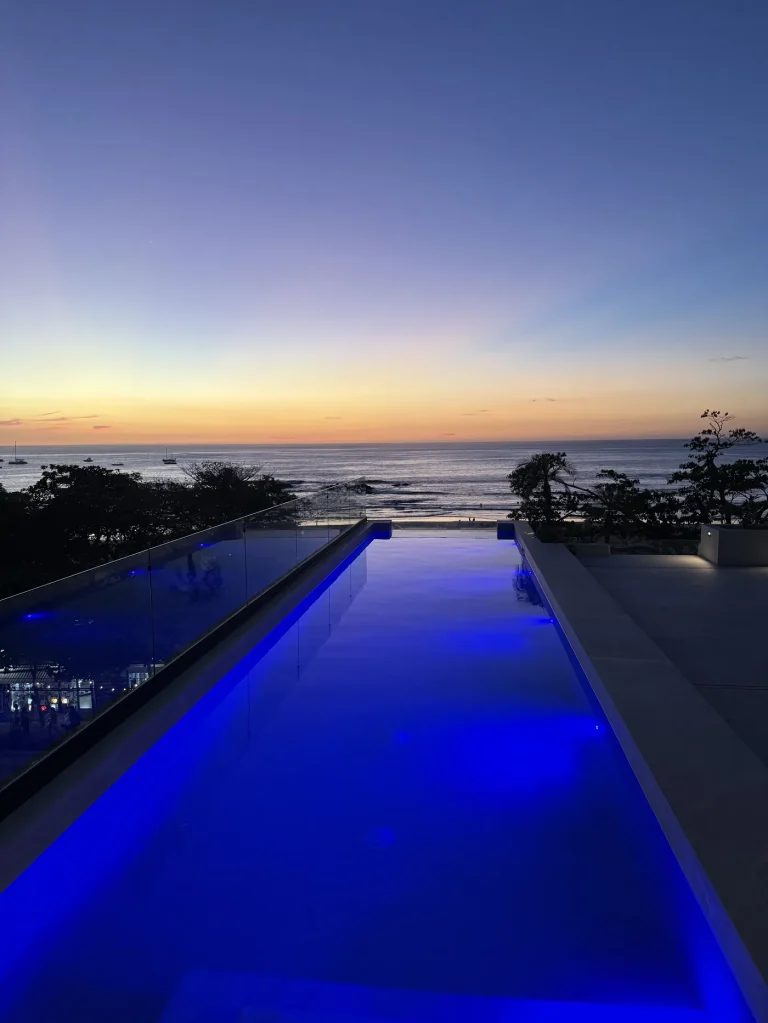
Best for: Surfers who want structured daily coaching with video review, in a small boutique-hotel format with a coastline-view rooftop pool. Saturday-to-Saturday packages, includes Liberia Airport pickup.
Iguana Surf is the newer hospitality side of a Tamarindo family business that’s been running the Iguana Surf shop on the main strip since 1989. The boutique hotel sits behind the main beach, with a rooftop infinity pool that looks straight out over the bay. The product is built around a structured weekly programme: daily lessons, video analysis sessions, an end-of-week photo package, and the standard Saturday-to-Saturday rhythm that most international guests are flying in on.
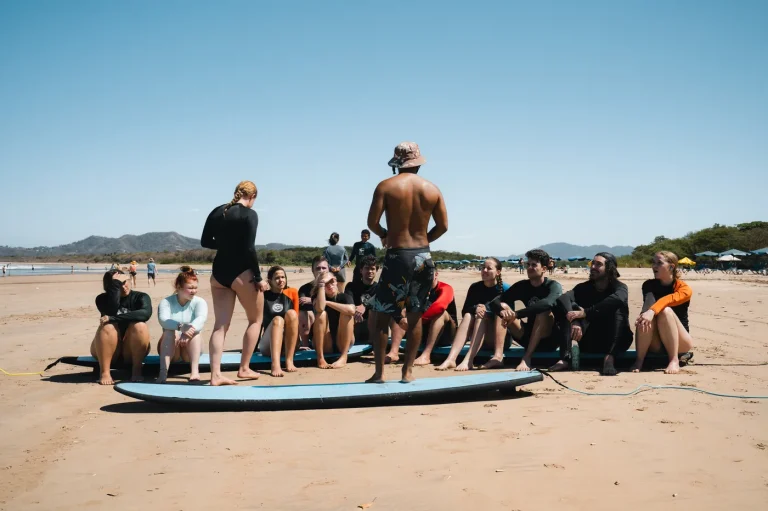
Packages start at 5 nights from $806 for the base, scaling to longer stays with weekly rates. The surf programme draws on the family’s 36 years of teaching in Tamarindo, which means instructors who know the bay’s sandbars and tide windows by name. Group lessons run at the main beach at standard learner-friendly hours; intermediate guests get coaching at Pico Pequeño when conditions match.
The trade-off: this is a small boutique property, not a 60-bed mega-camp. If you want a hostel-style party scene you’ll be in the wrong place. If you want a quieter base with coaching depth and a pool view, this is the closest fit in Tamarindo.
Best for: Surfers who want the most professional camp infrastructure in Tamarindo and the signature boat trip out to the actual Witch’s Rock break inside Santa Rosa National Park.
Witch’s Rock has been running in Tamarindo since 2001 and has hosted more than 50,000 surf vacations. The camp’s full name comes from the offshore break inside Santa Rosa National Park, reachable only by boat from Tamarindo. Their tiered programme is the clearest segmentation of any camp in this roundup: 7-night Beginner package at $2,290 per person, Intermediate at $2,690, and Advanced (with boat trips to Witch’s Rock and Ollie’s Point) at $3,190. Private room from $1,852 for 7 nights.
What you get for the price: 18 rooms at the main camp plus overflow at sister hotel Pueblo Dorado across the street, the on-site Eat at Joe’s restaurant (3 meals a day in packages), video review built into every package, a 250+ board demo centre, and the boat trips that no other Tamarindo camp can replicate at the same scale.
The honest take on reviews: instructors and staff consistently get strong marks; the recurring complaint is that “beachfront” oversells how close the property sits to the sand (reviewers measure around 200 feet from the hotel to the beach). Worth knowing if you booked expecting to roll out of bed onto the wave.
Best for: Solo travellers in their 20s who want eco-glamping accommodation, daily yoga, and a social camp where you’ll meet other guests within the first hour.
Dreamsea is one of the largest multi-location surf-camp brands in the world (13+ properties across France, Spain, Portugal, Morocco, Nicaragua, Bali, Sri Lanka and Costa Rica). The Tamarindo location is their original Costa Rica camp, set on the jungle side of town with bamboo lodges, glamping tents, and a few private suite options. Weekly packages include breakfast, dinner, 5 surf lessons, and daily yoga.
Pricing is the most varied in this roundup: dormitory bunk at $445 per person for the week, scaling to a Dreamsea Villa at $1,025, a River Suite at $1,500. The lower tiers are some of the most affordable structured surf weeks in Costa Rica.
The trade-off is well-documented on TripAdvisor: this is a party-and-surf camp, not a quiet retreat. Reviewers consistently report a strong social atmosphere and easy-to-meet-people energy. The negative reviews come from guests who expected serene yoga-and-surf and got something with more late-night noise. If you’re 22 and travelling solo, that’s a feature. If you’re 38 and reading TripAdvisor carefully, it’s a flag.
Best for: Surfers who want all-inclusive resort-style comfort (pool, gym, daily yoga, full board) in a less-crowded surf town than Tamarindo, with quick access to multiple breaks.
Rapture runs 8 surf camps across Bali, Portugal (three locations in Ericeira and Milfontes), Morocco (Tamraght, near Taghazout), Nicaragua and Costa Rica. The Costa Rica camp sits at Playa Avellanas, a 25-minute drive south of Tamarindo, with a coastline that has 5 surfable breaks at various tides plus quick access to Playa Negra (50 minutes south) and Playa Grande (north via the river crossing).
The product is bundled: surf instruction, daily yoga, three meals, pool access, gym, airport transfer. Pricing on third-party listings runs roughly USD 120 to 180 per person per night all-inclusive, which puts a 7-night week in the $840 to $1,260 range. Group sizes are smaller than Tamarindo mega-camps. Reviews lean hard on staff warmth, food quality, and the balance between surf time and downtime.
The trade-off: you’re not in walking distance of nightlife. Avellanas is a beach community, not a town. Dinner is on the property. If you want bars and restaurants after sundown, base yourself in Tamarindo and visit Avellanas for the day.
Best for: Budget travellers, families, and anyone who’s done Tamarindo once and decided the crowd ruined it.
Playa Grande Surf Camp is the smallest operation in this roundup and the only one positioned at the budget end. The property sits inside Parque Nacional Marino Las Baulas, on a beach that holds significantly less crowd than Tamarindo despite being a 5-minute boat shuttle across the river. Dorm beds run $23 to $34 per night, surf lessons are sold separately at $35 for a 2-hour group session with a 4:1 student-to-instructor ratio.
What you trade for the price: small property, basic amenities, no all-inclusive structure. What you gain: a wave that has more power and shape than Tamarindo, a beach the camp’s reviewers describe as having “one other surfer in the water” during lessons, and the unique seasonal draw of leatherback turtle nesting on the beach from December through February.
If you’re booking solo on a tight budget or building a longer Costa Rica trip and want a few days away from Tamarindo’s noise, this is the move.
The five camps split cleanly along three axes: how structured the coaching is, how much you want to spend, and how social you want the camp to feel.

 English
 Français
  Deutsch
  Español
  Italiano