 By Steeve
Sri Lanka has two surf seasons in two different parts of the country. The south coast works November to April. The east coast works April to October. This guide is the month-by-month map: what to expect at every spot, how to read the wind, and how to pick your dates based on the level you ride and the trip you want.
The two-coast surf calendar is driven by the monsoon cycle and the geometry of the island.
Sri Lanka sits just north of the equator in the path of two monsoon systems. The southwest monsoon runs roughly May to September: winds blow from the southwest, which means they are offshore on the east coast and onshore on the south coast. The northeast monsoon runs roughly November to February: winds shift to the opposite direction, becoming offshore on the south coast and onshore on the east.
Swell follows a similar pattern. The east coast catches the southwest swell directly during May to September. The south coast catches the southern-ocean swell during November to April when the winds have flipped offshore.
The practical takeaway: a clean morning surf needs both swell AND offshore wind on the same coast on the same day. That alignment only happens for 6 months at a time on each coast. The 4 weeks around April and the 4 weeks around November are the shoulder windows where conditions on one coast are tapering while the other is opening.
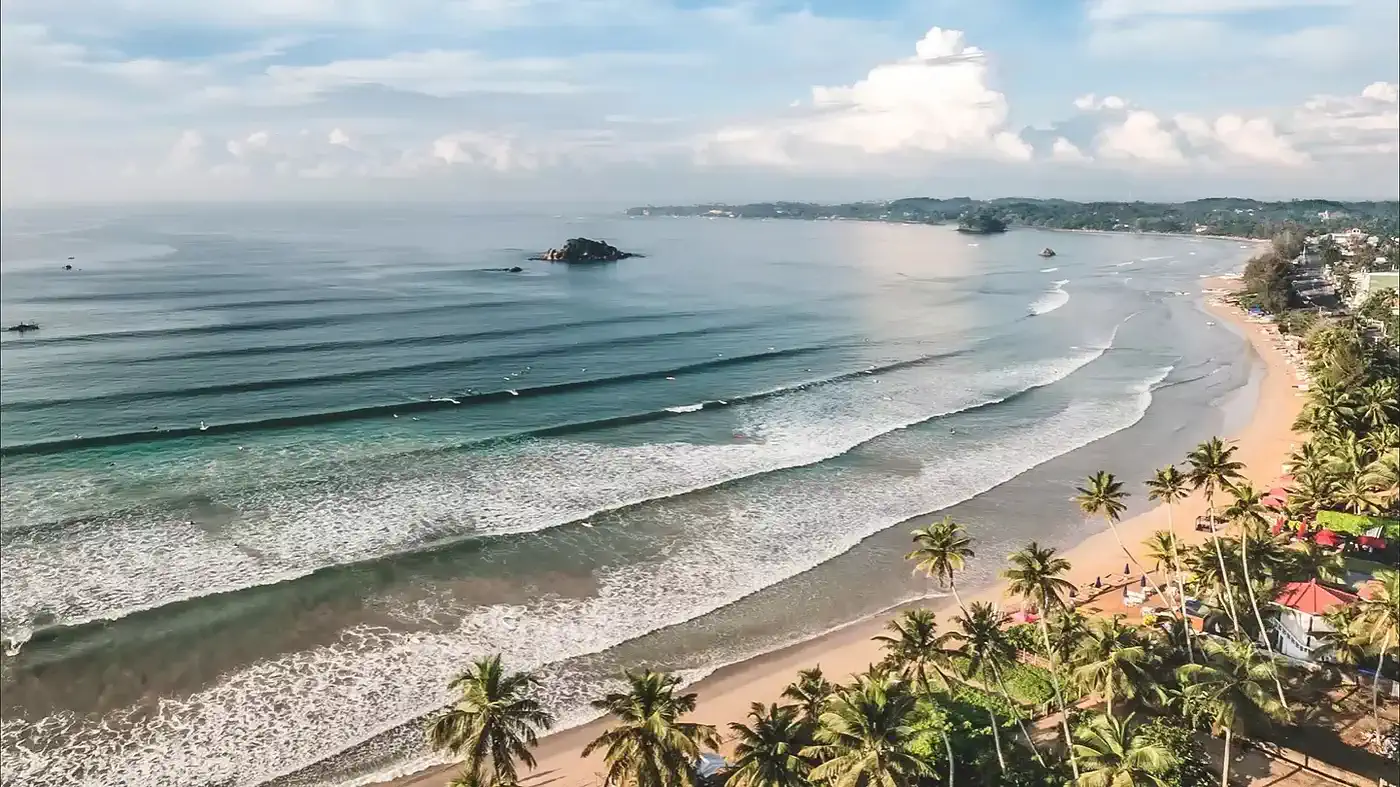
The south coast wakes up. The first clean swells arrive in the second half of October, but the wind only stabilises in early November. By mid-November the season is properly running.
Best for: Improvers and intermediates who want clean conditions without the December crowds.
The headline months for the south coast. Clean head-high waves, glassy mornings, the wave-of-the-year photos that show up on Instagram come from here. Also the most crowded weeks of the entire south coast season.
Best for: Any level, but only if you book early. The biggest variety of waves with the biggest scene.
The best wave-to-crowd ratio of the south coast season. Conditions are still consistent, water is clearest of the year, lineups are noticeably thinner than December and January.
Best for: Return surfers, improvers stepping up to reef points, anyone who can travel outside Christmas-New Year holidays.
One coast tapers, the other opens. April is the only month of the year when both coasts can be on the menu for a single trip, but neither is at its best.
Best for: Surfers who want to combine a south-coast week with an Ella-train stop and an early east-coast preview. Not the strongest single-coast pick.
The east coast season starts properly. Most Arugam Bay camps open between April 15 and May 1.
Best for: Improvers and intermediates who want Main Point on a quiet day.
Daily waves at Main Point. Whiskey Point starts running every day. Camps approach full capacity but stay below peak.
Best for: Return surfers, intermediates working on speed and turns, video-review programmes.
The headline months for the east coast. Main Point produces the long right-handers it is famous for, Pottuvil Point holds size on big swells, and the international surf scene shows up in force.
Best for: Advanced surfers who want size. Photographers. The trip that delivers the postcard wave.
The September equivalent of the south coast’s February. Quality is still excellent, water still 28 °C, crowd drops by half compared to August.
Best for: Return surfers, intermediates, anyone prioritising session quality over wave size.
Quality holds through the first half of the month, then tapers. Most camps close by October 31.
Best for: Last-minute east coast trips and tight budgets.
The water sits at 27 to 29 °C year-round on both coasts. No wetsuit. A rash vest is useful for sunburn protection (the equator-strength UV is the most underestimated risk on a Sri Lanka surf trip).
Air temperature is 27 to 32 °C in season. Humidity is high but the trade winds keep the coast bearable. Rain in the surf season is mostly brief afternoon squalls; multi-day rain rarely affects surf days, though it does affect transport and dirt roads near Arugam.
Sri Lanka is outside the major Indian Ocean cyclone belt. The country does occasionally see edge effects from cyclones in the Bay of Bengal during the November transition, which can produce one or two onshore-and-stormy days, but these are short-lived.
South coast in winter is the answer. December through March, Weligama or Mirissa, structured surf school with morning soft-board sessions. November or early March give the same quality with smaller crowds.
Either coast. The south coast offers more spot variety inside one tuk-tuk radius (better on bad-wind days). The east coast offers more consistency (Main Point breaks almost every day in season). Pick by what matches your travel window.
February (south) or June (east) for the best wave-to-crowd ratio. Both coasts deliver clean reef-point coaching at this level. Add a week of video review at a camp with a structured programme.
July and August at Arugam Bay Main Point for size and a competitive lineup. Hikkaduwa Main Reef in February for a heavier left-hander. Returning surfers who want both should plan a 10 to 14-day trip across April or November shoulder window.
Early November (south coast opening) or late September to October (east coast tail). Camp rates drop 20 to 30 percent compared to peak, and flight availability is wider.
Mid-September on the east coast. Mid-March on the south coast. Both windows have clean conditions with the lowest visitor numbers of their respective seasons.
Late July through early August at Arugam Bay. The southwest monsoon swell peaks here and Main Point can run overhead for multiple consecutive days.
December for the south coast: pair a Weligama week with Galle Fort, Yala safari, and a Mirissa whale-watching morning. February for the south coast: same combination with cleaner weather. July for the east coast: pair with Kumana safari and the Colombo-Kandy-Ella hill-country train.
Once you have your travel window, the coast is already chosen for you. From there it is a matter of picking the camp that matches your level. For the full country picture across both coasts, read the complete Sri Lanka surf guide. For coast-specific deep dives, see the South Sri Lanka guide and the Arugam Bay guide. To browse all Waverick surf camps in Sri Lanka with live prices and packages, go to the Sri Lanka destination page.
Plan your trip: Once you know your window, four Waverick Sri Lanka surf camps cover both seasons: south coast November to April at Ahangama and Weligama, east coast April to October at Arugam Bay. See which Sri Lanka surf camps are open this season →
February if you prioritise clean conditions with lower crowds (south coast). July if you prioritise the biggest, most consistent point-break waves (east coast Arugam Bay). Both are peak-quality months for their respective coasts.
Yes, by switching coasts. The south coast season runs November to April. The east coast season runs April to October. There is no month of the year when at least one of the two coasts is not in season.
Early November on the south coast or late September to October on the east coast. Camp rates run 20 to 30 percent below peak. Flights from Europe are also wider in availability in these shoulder windows.
South coast camps mostly close from May to October. East coast camps close from November to March. A few year-round operations exist on the south coast with reduced services in offseason, but the bulk of the surf-tourism infrastructure migrates with the season. Most coaches and instructors work both coasts across the year.
Yes, but it does not stop the surf trip. The southwest monsoon rain falls May to September, mostly on the south coast (which is offseason for surf anyway). The northeast monsoon rain falls October to January, mostly on the north and east. South-coast surf season (November to April) is dry; east-coast surf season (April to October) is mostly dry with brief afternoon squalls.
Rarely. Sri Lanka is outside the major Indian Ocean cyclone belt. The country occasionally sees edge effects from cyclones in the Bay of Bengal around the November transition, which can produce one or two onshore-stormy days but rarely longer disruption.
February or March on the south coast. The south coast bays (Weligama, Mirissa) have small, sandy beach breaks that are gentlest in these months, surf schools are running at full capacity, and the post-holiday crowd reduction makes lessons less hectic.
July at Arugam Bay for size. Main Point produces consistent head-high to overhead waves in late July through early August. For a left-hander option, Hikkaduwa Main Reef in February holds size on south-coast swell pulses. The 10 to 14-day window in either month gives a high chance of at least one peak-quality session.

 English
 Français
  Deutsch
  Español
  Italiano