 By Steeve
Sri Lanka is the rare surf country that works the whole year. The southern coast handles the European winter season from November to April. The east coast comes alive from April to October. Two coasts, two seasons, the same island. This guide is the map for a trip that lands in the right place at the right time.
Sri Lanka sits in the Indian Ocean just north of the equator. Swell here is generated by the Southern Ocean (working spring and summer) and by the southwest monsoon (working summer). The geometry of the island means the south coast catches the cleanest swell from November to April when winds are offshore there, while the east coast is wind-protected and swell-fed from April to October.
You cannot surf both coasts in the same week. The drive between them is 8 to 10 hours via the central highlands, and the wave window only overlaps for a few weeks in April and November. For a typical one-week trip, you pick one coast and commit to it. For a two-week trip in a shoulder month you can sample both.
The west coast around Hikkaduwa and Bentota gets some surf in the south coast season, but it is smaller and less consistent. We cover it briefly later because it suits a specific kind of trip.
Use this as the season map. Numbers are average swell height at chest to head-high spots.
The southern coast is one continuous surf zone of 25 kilometres between Hikkaduwa and Mirissa. Spots are close enough together that a single tuk-tuk driver can move you between three breaks in a morning.
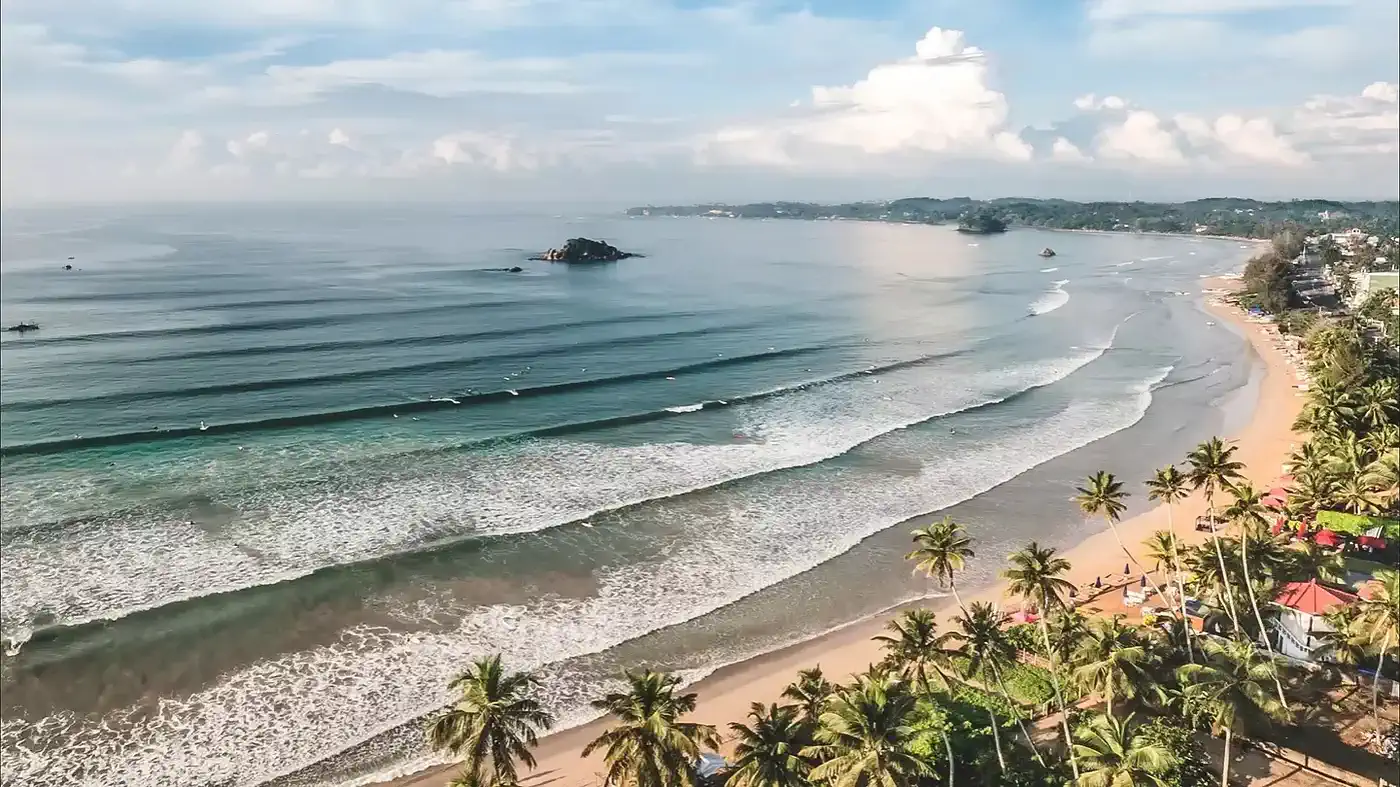
For first-time visitors, Ahangama is the sweet spot. It is close enough to Weligama and Mirissa for variety, short tuk-tuk rides to Coconuts and Kabalana, and the village has become the gravitational centre for surf travellers and coaches. Gota Dagua Surf Camp sits a short walk from Kabalana Beach and runs structured small-group lessons with daily theory, video review and the soft-board to performance-board progression that beginners and improvers need.
Weligama works if you want the biggest beginner-friendly bay and are happy to share it. The town itself is busier and more developed than Ahangama.
Mirissa suits couples and small groups who want a calmer base with whale watching and palm beaches alongside the surf.
Arugam Bay is a single street of guesthouses, restaurants and surf shops along a 2-kilometre crescent of sand. Behind it sits Pottuvil lagoon, a wildlife corridor where elephants cross the road on the way to the surf. Compared to the south coast, Arugam feels rural and surf-only. There are no historic harbours, no train stations, no major beach resorts. People come here to surf.
The town is small enough that any guesthouse on the main road works. The cluster around the southern end is closest to Main Point and Elephant Rock and works for surfers who want to walk to the morning session. Wanderlust Surf Camp sits on the eastern edge of the bay with walking distance to Main Point and tuk-tuk distance to Peanut Farm, Whiskey Point and Elephant Rock. It runs two coached lessons daily, weekly video analysis, and keeps a strict three-students-per-instructor ratio.
Hikkaduwa, Bentota and the coast just south of Colombo see south coast swells with extra refraction, which means smaller, mellower waves. The Hikkaduwa Main Reef can still get serious on big days, but most of the surf here is in the chest-high beach-break range.
This coast suits travellers who want a softer surf trip with easier logistics from the airport (Bentota is 90 minutes from Colombo). It also suits families combining beach holiday with surf lessons. Most surf camps in this zone are general beach resorts that add a school, rather than dedicated surf bases.
The south coast in season. Weligama Bay or Mirissa Beach with a structured surf school. Soft-boards, white-water, instructor in the water alongside you. Avoid Arugam Bay on your first trip: the points are crowded and the wave is unforgiving for the first 5 to 10 sessions.
Either coast. The south coast offers more spot variety inside one tuk-tuk radius, which means more options on bad-wind days. The east is friendlier on consistency because Main Point breaks almost every day in season.
Both coasts deliver. Ahangama Kabalana and Midigama Lazy Right on the south, Whiskey Point and Peanut Farm Inside on the east. This is the level that gets the most out of a video-review coaching programme.
Arugam Bay Main Point in July and August. Hikkaduwa Main Reef on a clean swell. Both produce 1-minute rides at head-high to overhead heights. The dedicated surfer should book a 10-day window to catch at least one swell pulse.
The country has two dedicated surf camp models. The south coast has more options, the east coast has fewer but more focused ones. Both follow a similar weekly rhythm: two coached sessions per day, video review, equipment included, daily breakfast, often yoga.
Waverick currently lists two camps that cover the two coasts:
You can browse both with live prices and full package details on the Sri Lanka destination page.
Bandaranaike International (CMB) in Colombo is the main entry point. Most camps will arrange a private transfer or recommend a driver. For the south coast, drive time is 2 to 3 hours via the southern expressway (E01). For Arugam Bay, drive time is 7 to 9 hours including a stop in Ella for the night.
Mattala International (HRI) serves Hambantota, theoretically closer to both coasts. In practice the route map is thin, so most surf travellers still fly into Colombo.
The southern expressway (E01) connects Colombo to Matara in 2 hours. The coastal train from Colombo Fort to Matara is one of the most scenic rides in Asia, but it is slow (4 to 5 hours) and runs over old infrastructure. Most surfers take the train at least once for the experience.
For Arugam Bay, there is no direct rail. The standard route is Colombo to Ella by hill-country train (8 hours, with cliffside tea-plantation views the whole way), then a 3-hour drive to Arugam. Camps usually arrange the Ella-to-Arugam private transfer for around €40 per car.
Once at a surf base, the daily routine runs by tuk-tuk. Rides between south coast spots cost 200 to 500 Sri Lankan rupees (roughly €0.60 to €1.50). In Arugam Bay, the morning shuttle to Whiskey Point or Peanut Farm is around 500 rupees per ride. Drivers strap surfboards on the roof and wait at the beach until you are done. It is the most reliable surf transport in Asia.
Sri Lanka is one of the cheapest tropical surf trips in the world. A practical 2026 budget for a one-week trip from Europe looks like this, excluding international flights:
Sri Lankan food is among the easiest in Asia for travellers. The base meal is rice and curry, but the curry is actually a board of 3 to 5 small dishes (dal, vegetable curries, sambols, papadum, sometimes a fish or chicken). Every south coast village has 2 to 3 local kades serving the same meal at slightly different prices. Most surf camps serve a Sri Lankan breakfast and dinner with international options layered in.
Beyond rice and curry, watch for kottu roti (chopped flatbread cooked with vegetables on a hot plate, eaten at 11pm after the bars close), egg hoppers (a bowl-shaped pancake with an egg in the middle, breakfast specialty), fish ambul thiyal (sour-spiced tuna in goraka, a black coastal version of fish curry), and king coconut (the orange-shelled coconut sold at every roadside, drink the water).
Sri Lanka rewards adding 3 to 4 non-surf days to a surf trip. The strongest add-ons:
Sri Lanka is the easiest tropical surf trip to organise. Pick a coast that matches your travel window, book a camp that matches your level, fly into Colombo and let the camp arrange the transfer.
Browse all Waverick surf camps in Sri Lanka with live availability and full package details, or read the regional deep-dives in this cluster covering the south coast surf spots, Arugam Bay and the east coast, and the month-by-month season guide.
Plan your trip: When you have picked your coast and your week, the four Waverick-verified Sri Lanka surf camps are listed side by side with live prices, full packages and instant booking. Compare Sri Lanka surf camps with real prices →
It depends on which coast you choose. The south coast (Ahangama, Weligama, Mirissa) works November to April, with the cleanest swell from December to March. The east coast (Arugam Bay) works April to October, peaking in July and August. December for the south and August for the east are the two safest windows for consistent waves.
Yes, particularly the south coast. Weligama Bay, Mirissa Beach and the inside section at Ahangama are sandy beach breaks with consistent small waves through the season. Water sits at 28 °C year-round, instructors speak English, soft-boards are everywhere, and surf-school prices are some of the lowest in the world. Arugam Bay is better for intermediates who can already paddle out and read a point break.
Match the coast to the calendar. November to April: south coast. May to October: east coast. April and November are shoulder months that can go either way. If your travel window is locked, the coast is already chosen for you.
No. Tuk-tuks handle all surf-spot transport on both coasts. Surfboards strap to the roof. A typical ride costs 200 to 500 rupees (€0.60 to €1.50). For inter-coast transfers (Colombo to Ahangama, Colombo to Arugam), camps will arrange a private car or van. Rental cars exist but most surfers do not bother.
Water sits at 27 to 29 °C year-round. No wetsuit. A rash vest is useful for sunburn protection and for sliding around on soft-board sessions. Most travellers surf in board shorts, a rash vest and reef-friendly sunscreen.
Yes. The surf bases on both coasts run as small, friendly communities where solo travellers integrate within a day. Women travel solo to Sri Lanka in significant numbers and the camps make it a default part of the booking flow. Standard travel sense applies: keep valuables in the camp safe, do not walk alone on empty beaches at night, watch your drink at bars.
Main Point gets crowded in July and August. The unwritten rules: priority to the surfer in the inside position closest to the breaking wave, no dropping in, no paddling around the lineup. Locals are patient and friendly, but the wave is the wave: a clean drop and a clear-out lane belongs to whoever was already on it. Your camp coach will teach you the rules on the first session.
Yes, and most travellers do. Yala National Park is 90 minutes east of Mirissa on the south coast and 4 hours south of Arugam Bay on the east. A half-day jeep safari runs €30 to €60. Udawalawe (better for elephants, lower density of leopards) is 2 hours north of Mirissa. Either fits as a one-day break in a 7-day surf trip.

 English
 Français
  Deutsch
  Español
  Italiano