 By Steeve
The south coast of Sri Lanka is the easiest tropical surf trip a beginner can take. Twenty-five kilometres of warm-water beach breaks, soft reef points, and sandy lineups between Hikkaduwa and Mirissa. The season runs November to April. The water sits at 28 °C all year. The schools, the camps, the food and the tuk-tuks are built around making it work.
Three things make South Sri Lanka the strongest beginner zone in Asia: the bottom, the wind and the wave size.
The bottom: most of the busy beginner spots are sandy, so a fall is just a soft landing in waist-deep water. The reef points (Coconuts at Ahangama, Madiha near Matara, Hikkaduwa Main Reef) are reserved for surfers who already paddle out cleanly. The white-water zones inside Weligama Bay and Mirissa Beach are pure sand, no rocks.
The wind: from November to April the southwest monsoon flips offshore on the south coast. Mornings are glassy, the wave face is clean, and the wind only turns onshore after lunch. This gives beginners a 4-hour clean-condition window every day to work on technique.
The wave size: south coast surf is small to medium, typically waist to head-high. The big swells of the year (December to February) come in clean and ordered, not heavy and closeout-y. Easy to read, easy to paddle.
If your travel window is locked, work backwards: November and March are the lowest-crowd quality months; December and January are the most reliable swells; February is the sweet spot for return visitors.
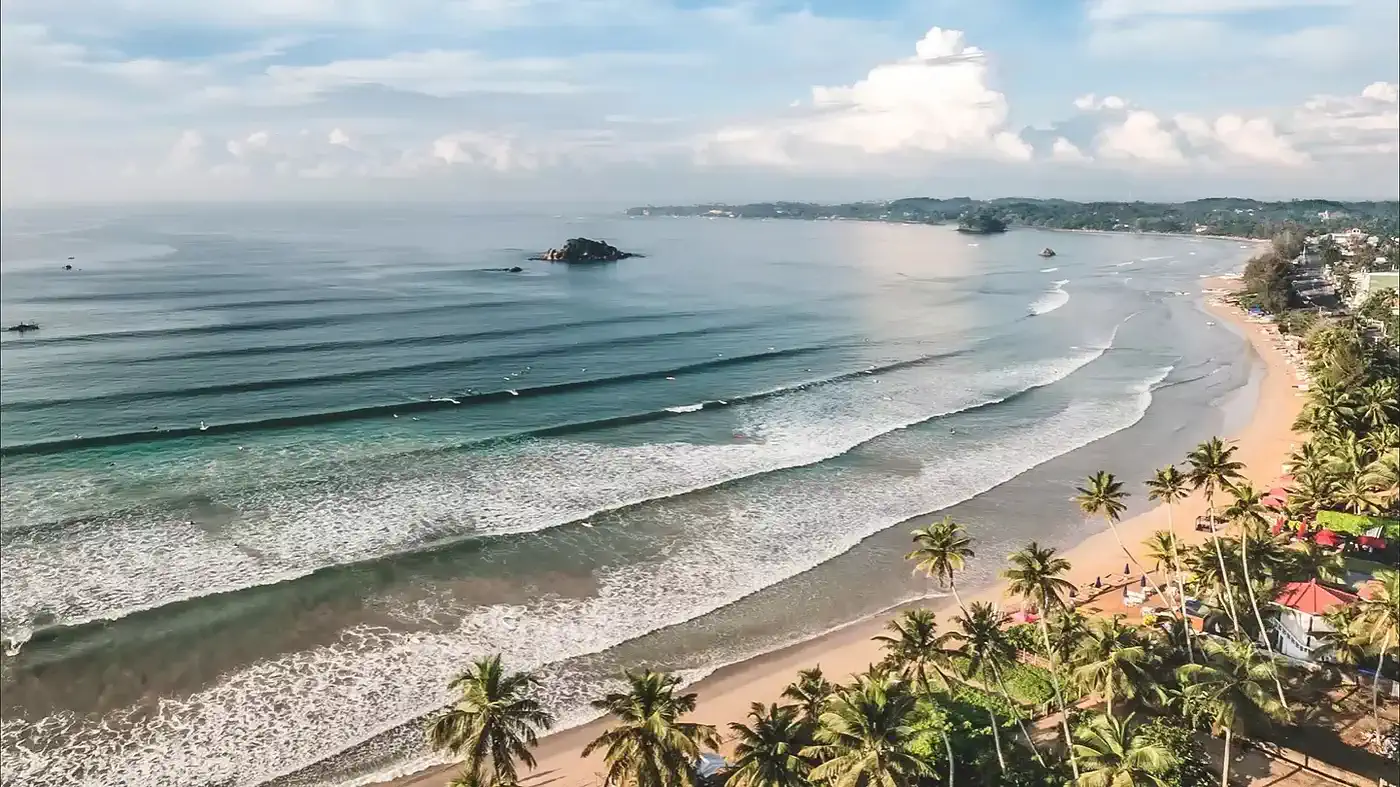
Weligama Bay is the surf school capital of Sri Lanka. A 2 km half-moon bay with sand bottom, gentle white-water rollers, and 30+ surf schools lining the beach road. On a typical December morning, 300 to 500 first-timers will be in the water with their instructors.
The wave runs all the way across the bay. Inside, near the river mouth, the white-water section is where lessons happen. Further out, the green-wave shoulder works for first-greens and pop-up practice. The middle of the bay holds the cleanest, longest rides on small days.
Crowd density. On any Christmas-week morning, 500 surfers and 30 instructors in a 200-metre stretch makes navigation hard. The intermediate and advanced surfer should look 10 minutes east to Midigama or Ahangama for cleaner sessions.
Ten kilometres east of Weligama, Ahangama is where surfers who graduated from Weligama go next. The village has become the centre of gravity for Sri Lanka’s surf-coaching scene, with dedicated camps, video review programmes, and a tight 5-spot rotation inside one tuk-tuk radius.
You get the same lessons quality with a fraction of the crowd. The wave variety is much wider: a beginner can spend the first three days on soft-boards in the white-water inside, then move to Coconuts for first-reef rides on day four. The food and accommodation scene around the harbour has also become the most polished on the south coast.
Gota Dagua Surf Camp sits a short walk from Kabalana. The programme is structured small-group lessons with daily theory sessions, video review, and the soft-board-to-mini-mal-to-performance-board progression. The camp runs November through April and works the full Ahangama rotation as wind and swell allow.
Five kilometres west of Weligama, Mirissa is a single beach inside a horseshoe bay. The wave is the most mellow on the south coast: small, sandy, and protected from the wind by the headland. A beginner will get more clean waves per hour here than anywhere else in the region.
Mirissa attracts surfers who want the trip slower. Couples, families with younger kids, surfers in their first-week-ever who want a quieter base than Weligama. The town has the south coast’s best beach restaurants and the morning whale-watching boats leave from the harbour at 6 am.
Hikkaduwa has been a surf destination since the 1970s and was Sri Lanka’s first international surf town. It is more developed than the rest of the south coast, with cafe culture, dive shops, and a long beach road of guesthouses.
Hikkaduwa works for a beginner trip that wants a more developed town with cafe culture and easier transport links (Bentota is closer for airport runs). Most surf schools here are added to general beach resorts rather than dedicated surf-only camps.
Ten minutes east of Ahangama, Midigama is the quieter, more advanced sibling. Three reef points break here: Lazy Right (clean, slow right), Lazy Left (rare, only on north-swell direction), and Ram’s Right (the punchier outside section).
This is the south coast for improver-to-intermediate surfers who want the same quality as Kabalana with fewer people in the water. The schools are smaller, the village is quieter, and the breaks are 200 metres apart so a single morning can include all three.
Two formats run on this coast: independent surf schools (you book lessons day-by-day, sleep wherever) and dedicated surf camps (week-package with accommodation, daily coached sessions, breakfast).
For most travellers, Ahangama is the right answer. The reasons stack up: best wave variety inside one tuk-tuk radius, strongest coaching scene, best food and accommodation polish, less school crowd than Weligama. Browse the Sri Lanka surf camps for current Ahangama options.
If you want the biggest beginner bay (Weligama) or the calmer family-friendly setup (Mirissa), pick those instead. If you want classic south-coast town culture, pick Hikkaduwa. The drive between any two of these is under 60 minutes.
Fly into Bandaranaike International (CMB) in Colombo. Three transport options to the south coast:
The south coast is the cheapest of the two Sri Lanka coasts. A typical 2026 budget for a one-week trip, excluding flights:
The south coast is the most beginner-friendly tropical surf trip in the world during the European winter window. Pick the village that fits your group, book a camp that fits your level, and let the tuk-tuks do the rest.
For the full country picture across both coasts, read the complete Sri Lanka surf guide. For the east coast in summer, see the Arugam Bay guide. To browse all Waverick surf camps in Sri Lanka with live prices, go to the Sri Lanka destination page.
Plan your trip: Ready to base yourself between Weligama and Ahangama? Three Waverick south-coast surf camps publish real prices, full packages and one-click booking on the directory. Book a south-coast Sri Lanka surf camp →
Yes. The south coast has sandy beach breaks (Weligama, Mirissa), structured surf schools, and gentle conditions inside the bays. Arugam Bay is mostly reef-point breaks that suit intermediate-and-up surfers. For a true first trip, the south coast is the answer in 9 out of 10 cases.
December through March, with February and March the cleanest crowd-to-quality ratio. The peak crowd weeks are Christmas and New Year. Mornings are glassy from sunrise to 11 am; the wind picks up after lunch. For maximum lesson time, book a camp that runs sessions at 6 am and 4 pm rather than 9 am.
Half the school crowd, roughly. Ahangama still gets busy in December and January peak weeks, but the wave variety spreads surfers across 5 spots within tuk-tuk distance, so any single lineup feels manageable. Weligama Bay is one wave with one beach, so the crowd concentrates.
From the surf, rarely. Whales are 5 to 15 kilometres offshore. The whale-watching boats from Mirissa harbour run from November to April, leaving at 6 am for a 4-hour trip. Blue whales are the headline sighting in February and March.
Coconuts is a softer, slower right-hand reef ideal for first-reef sessions. Kabalana is a punchier A-frame with steeper drops, suitable for intermediates working on speed and turns. Both break in the same 1 km stretch off Ahangama, so most camps rotate students between them based on swell direction and wind.
For a return surf trip, yes. The Hikkaduwa Main Reef is one of the strongest left-hand reef breaks in Sri Lanka and the town has more cafe and dive-shop culture than Ahangama. For a first-time visitor focused on lessons and progression, Ahangama or Weligama deliver more wave variety per day.
One week (7 nights) is the standard format and matches how the camps price their packages. Returning surfers often book 10 to 14 days to surf two swell windows and build up to reef-point sessions. Two weeks lets you combine Weligama (first week) with Ahangama (second week).
Bandaranaike International (CMB) near Colombo is the main entry, 2 to 3 hours by car to Ahangama via the southern expressway. Mattala International (HRI) is closer in theory but the route map is thin. Most camps will arrange a private transfer from CMB on request.

 English
 Français
  Deutsch
  Español
  Italiano