 By Steeve
Quick read: Canggu is Bali’s most social, most crowded, most year-round surf town. Five named breaks (Old Man’s, Batu Bolong, Echo Beach, Berawa, Pererenan) sit inside a 5 km strip of black-sand coast, and three of our four Bali partners live here. You can roll out of bed, grab a coffee at Drifter, walk to the line-up. That’s the whole pitch.
Canggu isn’t a single beach. It’s a 5 km black-sand stretch between Berawa in the south and Pererenan in the north, with Old Man’s and Batu Bolong as the social and surf-school heart in the middle. Coming from Uluwatu’s reef cliffs and Keramas’s drive-in heaviness, Canggu feels softer: sand-bottomed beach breaks for the first 100 metres of paddle, then reef peaks further out for anyone who wants more.
It’s also the town that doesn’t switch off. Year-round surf (smaller and friendlier in wet season, bigger sets May to October), warungs open till midnight, surf-shop culture you can actually walk into. Drifter Surf Shop on Jl. Batu Bolong is the cultural HQ. Deus Ex Machina, ten minutes north, is the surf-and-motor cafe everyone passes through on a Sunday. If you want one Bali base where you can surf in the morning, work in the afternoon, and have dinner with strangers by 9pm, this is the one.
Wave type: mush whitewater inside, faster reef peaks outside. Level: beginner to intermediate. Best tide: mid to high.
The main Canggu sandbank-and-reef combo and the social magnet. The inside is foam for surf-school day-1 students, the outside has a left and right reef peak that work on any swell over knee-high. Crowded by 8am, packed by 10. The Saturday session is the weekly ritual everyone in Canggu shows up to: live music on the beach, drinks, the same crew you’ve been seeing all week. Plan around it.
Wave type: long, sandy, forgiving. Level: first-timer ground zero. Best tide: mid.
The friendliest day-one wave in Bali. Long sandy paddle out, soft rolling sets, room to fall on your face without consequences. Every Canggu surf school launches from here, so by 9am the line-up looks like a yoga retreat that misplaced its mats. Go at 6.30am or accept the company. Walking distance from Old Man’s: five minutes north on the sand.
Wave type: reef break with sand-bottom front section. Level: intermediate to advanced. Best tide: mid, low for the heavier shoulder.
The Canggu wave that grows up. Holds overhead on a real swell, breaks with proper power, and the paddle out has more current than Old Man’s. When Old Man’s softens up and gets crowded, this is the next step. Five minutes’ walk north of Old Man’s, but it filters out the surf-school crowd by virtue of the wave alone. Sunset here is the local end-of-day move: warungs lined up along the sand, beer in hand, watching the last set roll through.
Wave type: small beach break and a softer reef on the south end. Level: beginner-friendly, less crowded. Best tide: mid to high.
The escape valve. Berawa sits south of Old Man’s, and on most days the wave is two-thirds the size of what’s breaking up the road. Less crowded, fewer schools, more space to actually catch a wave on your own without dodging six longboards. Two of our partner camps live here precisely because of this: walk five minutes south, paddle out, you’ve got room.
Wave type: reef break, less crowded. Level: intermediate. Best tide: low to mid.
5 km north of Old Man’s and the move for surfers who want to dodge the Canggu density without committing to the 90-minute drive south to Uluwatu. Cleaner reef break, fewer humans, slightly heavier wave. A scooter takes 15 minutes from Old Man’s. If you’re an intermediate who’s done their week at Old Man’s and wants to graduate, this is the local progression.
Local tip: Old Man’s Saturday is the social ritual nobody warns you about. Live music on the beach, the entire Canggu surfer crowd shows up by sunset, and you’ll meet more people in three hours than the rest of your week combined. Don’t book a flight out on a Sunday morning if you want to remember it.
May to October (dry season). The classic window. South-west swell pumps, Echo Beach gets its proper size, Old Man’s outside reef peaks are at their best. Daily clear skies, no rain, and the crowds reflect it: late July through August is the peak, with prices up 30-40% and Old Man’s looking like rush hour. June and September are the sweet spot. Solid swell, slightly fewer people, prices that haven’t fully tipped.
Wave size in dry season averages waist to chest at Old Man’s, head-high at Echo Beach when a swell lands. Trade winds blow offshore most mornings, glassing off the reef.
November to April (wet season). Smaller, softer, friendlier. Old Man’s becomes pure beginner gold (knee to waist, 80% of the time), Echo Beach softens into intermediate territory. Daily afternoon rain showers, usually 4-6pm, then back to clear evenings. Crowds drop, prices drop, and warungs are quieter. The local pivot when Canggu gets too small: drive 1 hour east to Keramas, where the east coast picks up swell from a different direction. Plenty of camps run day trips when the surf turns flat.
Canggu’s surf-culture HQ is Drifter Surf Shop (Jl. Batu Bolong, with a second location in Berawa). Boards, fins, photo prints, a cafe attached, and the kind of staff who’ll tell you which break is working before they sell you anything. Deus Ex Machina on Jl. Batu Mejan is the surf-and-motorcycle cafe that runs the Sunday Slowride: vintage motorbikes, art shows, occasional film nights. Both spots are walking distance from Old Man’s.
For dinner, the warungs win. €3-7 for nasi goreng or mie goreng done by someone who’s been doing it for thirty years, and you’ll eat better than at most €15 western menus down the road. Sunset is at Echo Beach: the row of warungs along the sand, a Bintang, the day’s last set. Saturday night is Old Man’s. Sunday is either the Slowride at Deus or the 30-minute drive south to Uluwatu for sunset at Single Fin.
Denpasar airport (DPS) sits 45-60 minutes south. Always pre-book a transfer (€10-15) or use Grab. Walking out of arrivals and grabbing a random taxi is the easiest way to overpay by triple. Most camps include the airport pickup if you ask, so check before you book.
Inside Canggu, the move is a scooter: €5-7 a day, helmet included, and you can rent from any warung with a sign. Walking distance covers Old Man’s, Batu Bolong, Echo Beach, Drifter, Deus, and most warungs from any camp in the central strip. For Pererenan or the drive to Uluwatu / Keramas, you’ll want the scooter or a Grab car.
Canggu is mid-range Bali. Cheaper than Uluwatu’s clifftop villas, more expensive than Lombok or Java, and broadly the same price-band as similar surf towns in southern Sri Lanka. A rough breakdown:
Avoid late July through August if you can. Camp prices climb 30-40%, line-ups double, and warung waits get longer. June, September, and the shoulder months either side of wet season give you the best value.
Three of our four Bali surf camps sit in Canggu, each with a different angle. In Da Surf Bali is the family-and-couples option: per-person villas with a private pool, half-board, and a slower pace. Best for parents travelling with kids who want a base that doesn’t feel like a hostel, from €75 a night.
Mondo Surf Village is the social one: 18-30 vibe, daily lessons with video coaching, group dinners, the camp where you’ll come home with a new WhatsApp group. From €100 a night, half-board with lessons. Soleia Surf Canggu is the middle ground: a mid-range surf-house in Berawa, quieter than Mondo, more structured than In Da Surf, with surf coaching and guiding packages from €90 a night.
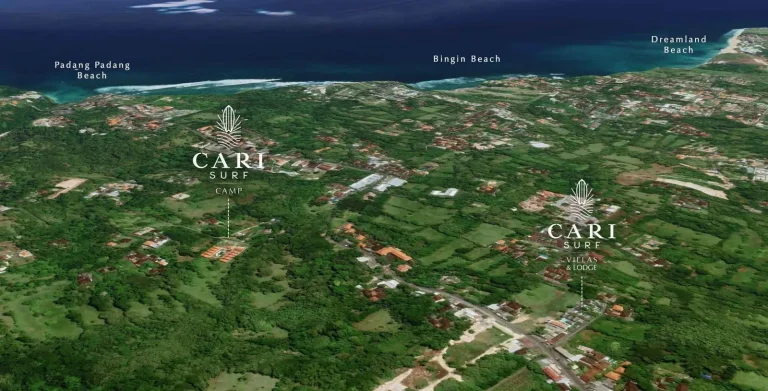
If you want Bukit reefs instead (Padang, Bingin, Uluwatu’s main wave), our fourth Bali partner CARI Surf Camp sits 30 minutes south in Uluwatu. Different scene, different wave, same booking flow.
Plan your trip: Once you know which region fits, browse all Bali surf camps with real prices, packages and verified reviews. CARI Uluwatu, In Da Surf, Mondo and Soleia (Canggu) in one place.
Yes, it’s one of the easiest places in Asia to start surfing. Batu Bolong is a long, sandy, forgiving wave with no rocks and waist-high sets most of the year. Old Man’s inside has soft whitewater you can ride for thirty seconds at a time. Pretty much every Canggu surf camp runs daily group lessons for €25-35 with board and rashie included.
Batu Bolong if it’s your first or second time on a board. The bottom is sand, the wave is slower, and the schools are concentrated there for a reason. Old Man’s once you’re up and standing on whitewater, since the inside is friendly but the outside reef peaks pick up faster. Most camps will move you between the two as you progress.
Walk five minutes south back to Old Man’s inside or Batu Bolong, both of which will be smaller and more forgiving. If even those feel heavy, scooter ten minutes south to Berawa, where the wave is consistently two-thirds the size of what’s running up the road. Wet season generally takes 30-50% off the swell across all Canggu spots, so timing helps too.
Canggu, almost always. Uluwatu’s main waves are reef breaks at low tide with sharp coral and a heavy paddle out, suited for confident intermediates and up. Canggu is sand-bottomed, surf-school dense, and walkable. You can always day-trip 30 minutes south to surf the Bukit on a calmer day once you’ve found your feet.
All the time, just smaller. November to April runs knee to chest most days at Old Man’s, with the occasional bigger swell. Echo Beach drops into easier intermediate territory. Daily afternoon rain showers (4-6pm) are normal, but mornings and evenings stay clear. When Canggu does go flat, the local move is a 1-hour drive east to Keramas, where the east coast picks up swell from a different angle.
Honest answer: very. By 8am in dry season you’ll see 80-100 surfers in the line-up across the inside and outside peaks. Saturday around sunset adds another layer of social crowding. The fix is timing: paddle out at 6am for a clean hour, take a break during the 8-11am rush, come back at 4pm when most schools have wrapped up. Or scooter to Berawa and Pererenan when the density gets silly.
Berawa for quieter, fewer scooters out front, smaller waves, more residential feel. Two of our three Canggu partners (Soleia and parts of In Da Surf) sit here. Echo Beach and Old Man’s for walking-distance access to the main social action and bigger waves, at the cost of more traffic and more buzz at night. If it’s your first Bali trip, central is the easier call. Repeat visitors often migrate to Berawa.
Plenty going on. Drifter Surf Shop and Deus Ex Machina double as cafes and culture stops. Yoga studios are everywhere (most camps include a class or two). Scooter inland 30 minutes for the Tibumana waterfall or the Sangeh monkey forest. Or commit to the 90-minute trip to Ubud for a couple of nights of rice paddies and warung dinners away from the coast. Sundays often end at Single Fin in Uluwatu, 30 minutes south, watching the cliff-top sunset.

 English
 Français
  Deutsch
  Español
  Italiano